A first RC plane
An RC plane kit is a boxed model aeroplane supplied as parts rather than as an aircraft: printed sheets of balsa or a set of foam mouldings, the spars and formers, the covering film, and instructions, with the motor, servos, receiver and battery bought separately and fitted by the builder. It is one of the three ways a first model aeroplane is sold, alongside the almost ready to fly airframe that arrives assembled but empty, and the ready to fly package that contains everything including the transmitter. Which of the three a beginner should buy depends entirely on whether they want to learn to fly this year or to learn to build first.
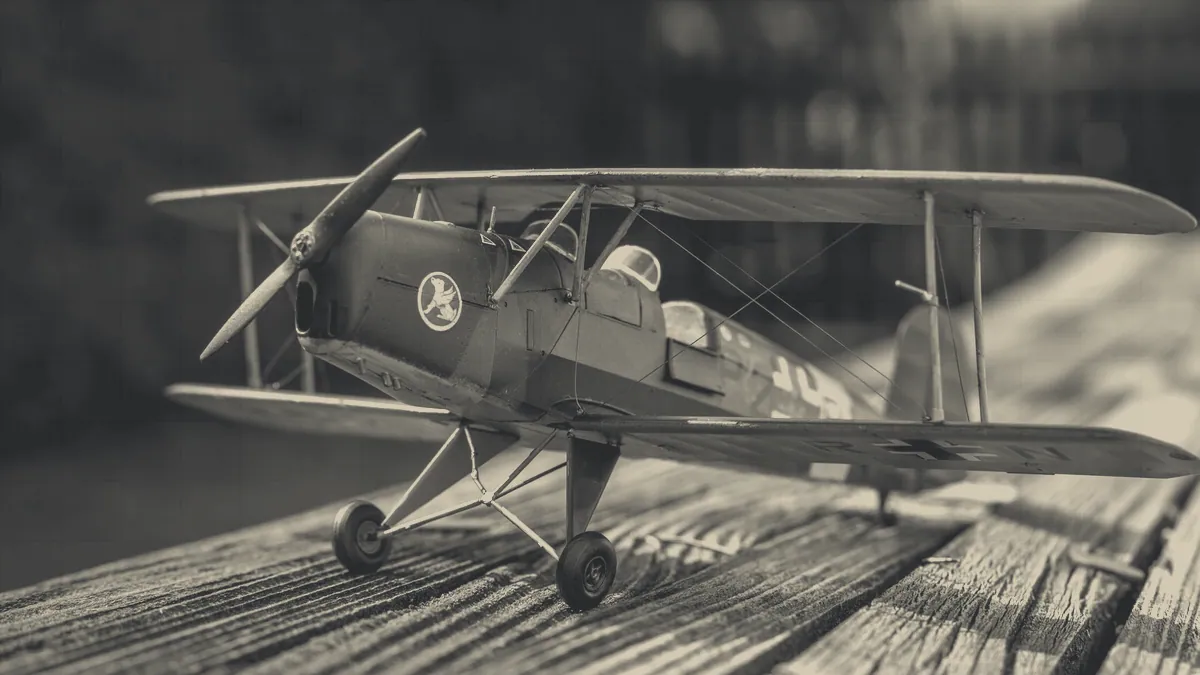
What a first model aeroplane actually is
A first model aeroplane is a trainer: a high wing aircraft with a large, thick, flat bottomed wing set above the fuselage, a pronounced upward angle to each wing panel, and enough surface area that it flies slowly and lands slowly. That geometry is not a styling choice. Hanging the weight below the wing and angling the panels upwards makes the aeroplane want to level itself, so when a beginner lets go of the sticks in a panic the model rolls upright and carries on rather than continuing into the ground.
Trainers come in 3 or 4 channels. A 3 channel model gives rudder, elevator and throttle, which is 2 servos and a speed controller, steers its turns with the rudder and is the gentlest thing in the class. A 4 channel model adds ailerons and the servo that works them, turns properly, and is the aircraft a pilot has to move to eventually. Buying the 4 channel version and flying it as a 3 channel model for the first month is the usual compromise. Radio controlled aircraft as a family are worth understanding first, if the choice between a wing and a set of rotors is still open.
What flying a trainer is actually like
Flying a trainer is harder than the box suggests and easier than a helicopter, and the difficulty is concentrated in two places: the first thirty seconds and the last thirty seconds. In between, a trimmed trainer flies almost hands off, and beginners are often surprised how little the sticks need to move. Take off and landing are where the models are broken.
The one problem nobody warns a beginner about is reversed orientation. When the aeroplane is flying away, left stick turns it left. When it turns and comes back towards the pilot, left stick still turns the aircraft left, which now looks like right. Every new pilot gets this wrong, usually on the approach, usually low. The cure is time, and the standard shortcut is a buddy box: two transmitters on the 2.4 GHz band joined by a lead, with an experienced pilot holding the master and able to take control back instantly. Most clubs affiliated to the British Model Flying Association will offer this to a visitor, and an afternoon on a buddy lead saves more airframes than any amount of reading.
Caution
An electric model aeroplane is armed the moment the flight battery is plugged in, and a propeller that starts unexpectedly on a workbench will cut a hand badly. Connect the battery last, with the model pointing away from people, the throttle stick down and the transmitter already switched on. Disconnect the battery before touching anything near the propeller.
What it costs to get into a first model aeroplane
The cost of a first model aeroplane is not the aeroplane. A complete foam trainer with a simple transmitter, a battery and a charger in the box sits in the under one hundred pound band, and that figure is what most people budget. The rest of the first year is in the parts nobody mentions:
- Buy two or three spare flight packs, because one pack is a single short flight.
- Buy a charger that balances cells, rather than the wall plug supplied with a starter set.
- Buy a computer transmitter once a second model appears, in the one hundred to three hundred pound band.
- Buy spare propellers by the packet, since a propeller is the cheapest thing that breaks and the most frequent.
- Pay club membership and national body membership, which together sit in the modest annual band.
- Replace the airframe at least once, and treat the first one as a consumable.
A kit built model with separately chosen electronics reaches the two hundred to five hundred pound band before it has flown, and that is before the tools. The field is the cost people genuinely forget. A trainer needs a mown strip and clear approaches, and in most of the United Kingdom that means joining a club rather than using a public park.
A first RC plane against a multirotor drone
A first RC plane beats a multirotor drone on endurance, on running cost and on what it teaches, and loses to it on everything to do with a camera. The aeroplane stays up longer on the same battery because the wing carries the weight, it is repaired at the field with foam glue and tape, and a broken one costs a fraction of a broken camera drone. It also produces a pilot. Quadcopters hold themselves level through a flight controller, so a beginner who buys one learns where to fly rather than how, and the skill does not transfer back.
Where the drone wins is plain and worth saying: it takes off vertically from a small space, it hovers, it holds a stabilised camera on a subject, and it can be flown alone without a club or a strip. A first drone answers that reader better than any trainer, and a trainer will not give them a usable photograph.
Kits, balsa and the ready to fly model
Kits divide into two materials, and they are two different pastimes. A balsa kit is the traditional form: die cut ribs and formers pinned over a plan, glued, sanded, and covered in heat shrink film pulled tight with a covering iron. It takes weeks of evenings, it produces a lighter and better flying aeroplane than any foam model, and it is the reason a large part of this hobby is adults who fly rarely and build constantly. A foam kit assembles in an evening with a tube of glue and forgives crude workmanship.
Building teaches the thing that flying does not: what is inside the aeroplane. A builder who has installed their own servos, set the control throws and balanced the model on their fingertips can repair anything and can diagnose a fault. A ready to fly buyer cannot, until the first repair teaches them. The honest advice is that a beginner who buys a kit and no ready to fly model tends to spend a winter building and a single afternoon crashing.
Should you start with a model aeroplane?
Yes, if you want to learn to fly rather than to take photographs. A trainer is still the cheapest, fastest and most forgiving way to acquire real stick skill, it is repairable, and every other class in the hobby becomes easier afterwards, including RC helicopters, which are not a reasonable starting point for anybody. Start here if the flying is the point.
No, if the aircraft is a means to a picture, if there is no club or open ground within a sensible drive, or if the buyer has no appetite for repairs. Those readers are better served by a small camera machine, and should note that any aircraft over 250 grams brings registration and competency requirements under the Civil Aviation Authority scheme. Those requirements change, and the Civil Aviation Authority is where the current position is published.