FPV goggles
FPV goggles are a head worn display that shows the live picture from a camera on the aircraft, so that you fly from the drone's point of view rather than from the ground. FPV stands for first person view, and the change it makes is total: a quadcopter seen from a field is a small object being positioned, and the same quadcopter seen through goggles is a machine you are sitting in. Everything else on this page follows from that one difference, including the fact that while the goggles are on your eyes, your eyes are not on the aircraft.
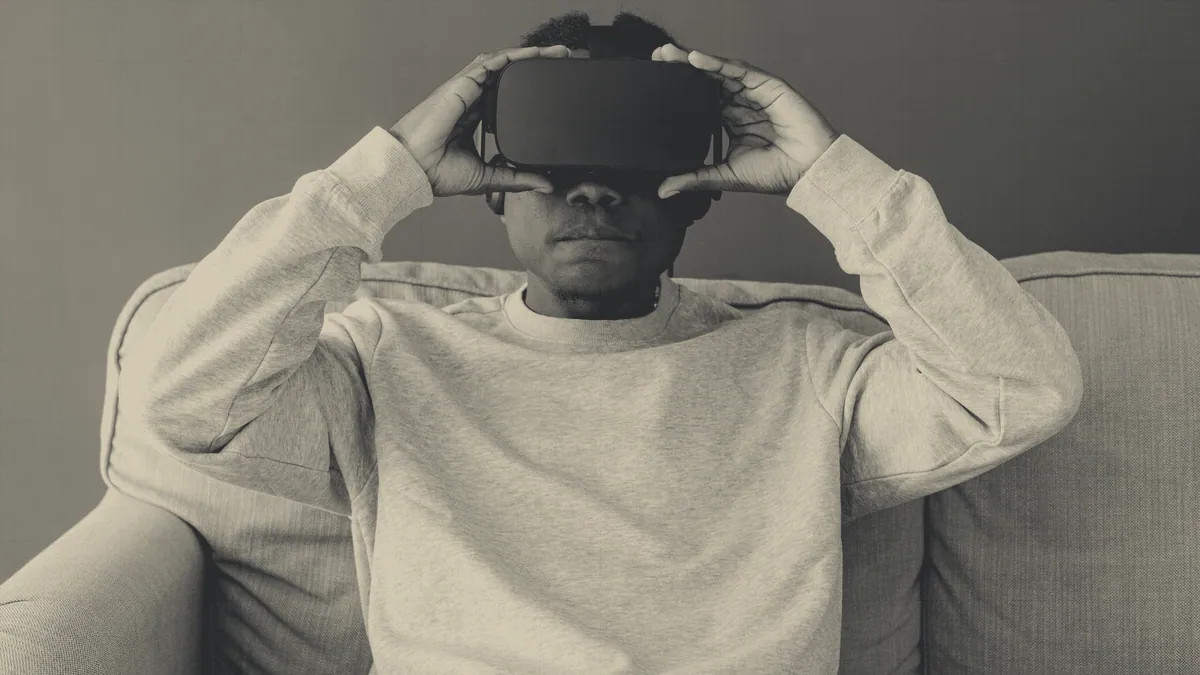
What FPV goggles are
FPV goggles are a receiver and a screen in a single housing worn on the head, taking a live video signal from a transmitter on the aircraft and putting it in front of the eyes at an apparent size of a cinema screen. The picture arrives over its own radio link, almost always on the 5.8 GHz band, entirely separate from the 2.4 GHz control link that carries your stick movements. Two radios, two directions, one aircraft.
What distinguishes goggles from the rest of the kit is that they are the only component that changes the pilot rather than the aircraft. Fitting them alters nothing about how the machine flies and everything about how it is flown, and it alters one thing that is not a matter of preference at all: with goggles on, you are no longer looking at the aircraft, and the requirement to keep it within sight is a requirement the Civil Aviation Authority publishes and does not waive because the picture is good.
The numbers on FPV goggles and what they mean
Goggles are sold on six figures, and the first two decide whether they will work with your aircraft at all while the rest decide whether they are comfortable to wear.
| Figure | What it measures | What happens when it goes up |
|---|---|---|
| Band and channels | 5.8 GHz, divided into bands of eight channels, 40 in total on the common layout | More channels means more flyers can share a field without interference |
| Field of view | How wide the image appears, in degrees | More immersion, and a greater chance the edges are soft or the image is hard to take in at a glance |
| Panel resolution | Pixels across each eye's display | A sharper picture, which an analogue signal may not be able to fill |
| Latency | Delay between the camera seeing something and you seeing it, in milliseconds | Worse. This is the one figure where lower is always better |
| Interpupillary distance | Spacing between the two lenses, in millimetres | Nothing, but it must match your own eye spacing or the image will not merge |
| Battery capacity | Milliamp hours in the goggle pack | Longer sessions, more weight on your face |
Latency is the figure that matters most and the one least often understood. It is the total delay through the camera, the transmitter, the receiver and the screen, and it is what decides whether you can fly through a gap at speed. Analogue systems have very little of it. Digital systems have more, and publish the figure, and the good ones have brought it down far enough that racing pilots use them. One number is not on the box and should be: the output power of the video transmitter on the aircraft is limited in the United Kingdom by Ofcom, the limits are published as conditions for licence exempt use, and a transmitter bought from outside the UK may be built for a different limit.
How FPV goggles fail
Goggles fail in two entirely different ways depending on whether the video link is analogue or digital, and the difference is the single most important thing to understand about the choice between them. Analogue degrades. Digital falls off a cliff.
- Analogue picture breakup: static creeps in from the edges, the image tears, colour is lost, and a usable outline remains long after the picture has stopped being pretty.
- Digital link loss: the image stays sharp, then freezes into blocks, then goes black with no warning and no residual outline to fly home on.
- Lens fogging, on a cold day or after walking to the spot, which clears in a minute but not the minute you need.
- Light leak through a worn or badly seated foam face gasket, which washes out the image in sunlight.
- Antenna damage, usually to the exposed lobe of a circularly polarised aerial, which shortens the usable range dramatically without any other symptom.
- Goggle battery exhaustion, which turns off the display while the aircraft is still airborne.
In the air, the analogue failure feels like flying into fog: you notice the picture roughening as you pass behind a building or drop below a hedge line, and you have time to turn back before it goes. The digital failure feels like a light being switched off. Both are why flyers keep the aircraft close and in sight, and why a spotter standing beside you watching the machine with unaided eyes is the standard practice at every organised flying site in the country.
Caution
You cannot see the ground, other people or a change in the weather while wearing goggles. Take off and land with the goggles lifted, keep another person beside you watching the aircraft, and never fly in goggles where somebody could walk into you or where you could step backwards into a road, a ditch or water.
Choosing and connecting FPV goggles
To choose goggles, start from the aircraft's video system, because goggles do not work with any drone. That is the question most often asked and the answer is no: goggles receive a particular kind of signal, and they will show a picture only from an aircraft transmitting that kind of signal. Analogue goggles will receive analogue from any manufacturer, which is the great strength of the analogue standard. Digital systems are proprietary, and a digital transmitter generally talks only to that manufacturer's own goggles. A camera drone that streams its picture to a phone over its control link is a third case again, and its video will not appear in goggles at all unless the manufacturer sells goggles for it.
- Establish what the aircraft transmits: analogue on 5.8 GHz, a named digital system, or a phone stream over the control link.
- Match the goggles to that system before considering anything else about them.
- Fit and orient the aerials on both the goggles and the aircraft, since a bent or missing aerial costs most of the range.
- Power the aircraft first, then the goggles, so the receiver has a signal to find.
- Set the band and channel on the goggles to match the transmitter, or use the automatic search if the goggles have one.
- Adjust the lens spacing to your own eyes until the two images merge into one, and fit the dioptre inserts if you wear glasses.
- Check the picture on the ground at a distance before flying, walking the aircraft away while somebody holds it.
The handset is a separate matter and a separate bind. Goggles carry video and nothing else; the controller carries your commands and, on most systems, the telemetry. A bundle sold as a kit with an aircraft, goggles and a controller together has already been bound and matched at the factory, which is why it is the sensible first purchase and why buying the three pieces separately is a job for somebody on their second build. The parts of a drone sets out how the video system sits alongside the rest of the aircraft, and Motors and speed controllers covers the components that share the airframe with the video transmitter and are the usual source of the interference that spoils an analogue picture.
The alternatives
There are three choices to make: analogue or digital, box goggles or low profile goggles, and goggles or a screen. Analogue is cheap, universal between brands, has the lowest latency of anything available and degrades gracefully. Its picture is soft and full of noise, and it always will be. Digital is sharp enough to be worth recording, holds a clean image to the edge of its range, and costs several times as much, is locked to one manufacturer, and goes black rather than fading.
Box goggles put one large screen in a single housing in front of both eyes. They are bulky, they look absurd, and they are much cheaper for a given image size, which makes them the sensible way to find out whether you enjoy first person flying before spending seriously. Low profile goggles use two small screens and a lens for each eye. They are lighter, they pack into a bag, and they cost more.
The case where goggles are not the answer at all is worth stating, because it is common. A screen mounted on the controller shows the same picture, lets you glance up at the aircraft whenever you want, and is accepted in situations where goggles are not, which the Civil Aviation Authority sets out and revises. Anyone flying a camera drone for photography rather than for the flying is better served by the phone on the handset than by goggles. Radio controlled aircraft is the older hobby all of this grew out of, and most of it is still flown by looking at the model.
Goggles and the requirement to keep the aircraft in sight
Flying with goggles on affects your ability to meet the requirement to keep the aircraft within your unaided visual line of sight, because while the goggles are on you are looking at a screen and not at the aircraft. This is not a detail. It is the requirement the whole practice of first person flying has to be arranged around, and it is the reason a competent flyer never puts goggles on alone.
The authority that publishes the requirements is the Civil Aviation Authority. They set out what visual line of sight means, what is expected of somebody flying with a camera view, and the circumstances in which another person acting as an observer is part of the arrangement. Those requirements change, they have changed more than once, and they differ according to the weight and class of the aircraft and where you are flying it. Nothing on this page is a statement of what you personally may do. Read the rules pages on this site for how the UK requirements are structured, and check the current text at the Civil Aviation Authority before you fly in goggles.
Are FPV goggles worth buying?
Yes if you want to fly, and no if you want pictures. Goggles are the single purchase that most changes what the hobby feels like, and no other component comes close: a cheap analogue set on a cheap ducted quadcopter delivers more of the actual experience of flying than an expensive camera drone ever will. For anybody who is drawn to the machine rather than to the footage, this is the first thing to buy after the aircraft.
They change only the receipt in two cases. The first is the photographer who wants stabilised video of a coastline, for whom goggles add cost, add a person to bring along and add nothing to the footage. The second is the upgrade from a working analogue set to digital on an aircraft that is flown gently in an open field, where the sharper picture is pleasant and changes nothing about what you can fly. In both cases the money does more elsewhere: a second battery, a spare set of propellers, or landing pads, which cost very little and keep the grit out of everything else you own.