Fixed-wing drones
A fixed-wing drone is an unmanned aircraft that carries its weight on a wing, the way a model aeroplane does, and uses its propeller only to push itself forward rather than to hold itself up. That one decision changes everything else about the machine. A quadcopter stays in the air by throwing air downwards continuously, which costs power every second it is airborne; a wing converts forward speed into lift, so the motor only has to overcome drag. The result is an aircraft that flies much longer and much further on the same battery, and an aircraft that cannot stop. A fixed-wing drone that stops moving forward stops flying.
Where this class sits
Typical take-off weights for this class, on the same scale used on every class page, so the twelve can be read against one another. The only figure here with legal force is the 250 gram line.
What a fixed-wing drone actually is
A fixed-wing drone is a powered model aeroplane flown from the ground by radio, usually built from moulded foam, with a wingspan that runs from roughly half a metre on a park flyer to two metres or more on a survey airframe. Under the skin it carries the same parts as any other hobby aircraft: a lithium polymer battery, an electronic speed controller, a receiver bound to a handheld transmitter, and a flight controller that may do nothing more than damp the airframe or may fly a whole route on its own. What it adds is a set of moving control surfaces. A flying wing has two elevons along the trailing edge that pitch and roll the aircraft together. An airframe with a tail has ailerons, an elevator and usually a rudder, each doing one job.
The word drone covers all of this and a good deal more besides, and the senses it carries are separated on What a drone actually is. For the purposes of choosing a machine, the useful split is not between a drone and a model aeroplane, which the scheme treats under the same heading of unmanned aircraft, but between an aircraft that hovers and an aircraft that does not.
What separates a fixed-wing drone from the rest
What separates a fixed-wing drone from the rest is that the wing does the lifting, and a wing only lifts while air is moving over it fast enough, so every fixed-wing drone has a minimum flying speed below which it stalls and drops. That is the specification the whole class hangs on, and it is an engineering decision rather than a marketing label. Three things follow from it directly.
- It cannot hover, hold a position, or take a still shot of one fixed thing.
- It needs open ground at both ends of the flight, to launch into and to land on.
- It is far more efficient in the cruise, so its endurance advantage over a multirotor is a multiple rather than a few extra minutes, and the advantage grows with size.
Put a number on the other side of that comparison and the gap is easy to see. A small camera multirotor typically gives 15 to 25 minutes in still air. A foam wing built to a similar weight will comfortably beat that, and a larger one flying a survey pattern is measured in a different unit again. Wind changes the arithmetic in the wing's favour too: a multirotor fighting a headwind burns its battery holding station, while a wing simply makes slower progress over the ground and can often use the wind to climb.
What a fixed-wing drone costs
Prices for fixed-wing drones sit in three bands, and the bottom one buys less than a beginner expects. Under fifty pounds you get a foam park flyer or a powered glider: a brushed motor, three channels, no stabilisation, no camera and no telemetry. It flies, it teaches you to land, and it will not carry anything. The band from around one hundred pounds to three hundred pounds is where the class becomes useful. That money buys a brushless motor, a stabilised flight controller with a self-levelling mode, a wingspan large enough to be steady in British wind, a mount for a small camera, and spare parts that are actually sold separately. Above that, the money goes on autopilot features rather than on flying: waypoint navigation, a longer control link, a bigger payload bay, a thermal or mapping camera, and the ground station software to plan a route.
Paying more stops changing the flight itself somewhere in the middle band. A larger wing is calmer in rough air and carries more, but a well trimmed foam wing at three hundred pounds and one at three thousand fly in recognisably the same way. The extra buys a mission, not a better aeroplane. It is worth knowing that this is a small market compared with camera multirotors, so the ready to fly choice is narrow, and a good part of the class is sold as a kit, a bind and fly airframe with no radio, or a set of plans and parts.
What to check before buying a fixed-wing drone
- Measure the wingspan against the field you actually have, not the one you would like.
- Read how it launches: by hand, off a bungee, from a catapult, or on an undercarriage that needs a smooth strip.
- Read how it lands, because most of this class lands on its belly, and check what the underside is made of.
- Confirm the flight controller has a self-levelling mode and, if it is offered, a return to launch.
- Weigh the whole aircraft as flown, battery and camera included, and note where it sits against 250 g.
- Check whether the camera is bolted to the airframe or carried on a gimbal, because a fixed camera moves with every roll.
- Check the channel count on the radio and whether a receiver and transmitter are included at all.
- Check the battery cell count and connector, and whether a charger comes in the box.
- Search for the spares before you buy: a wing, a fuselage half, a motor mount and a propeller.
What flying a fixed-wing drone is like
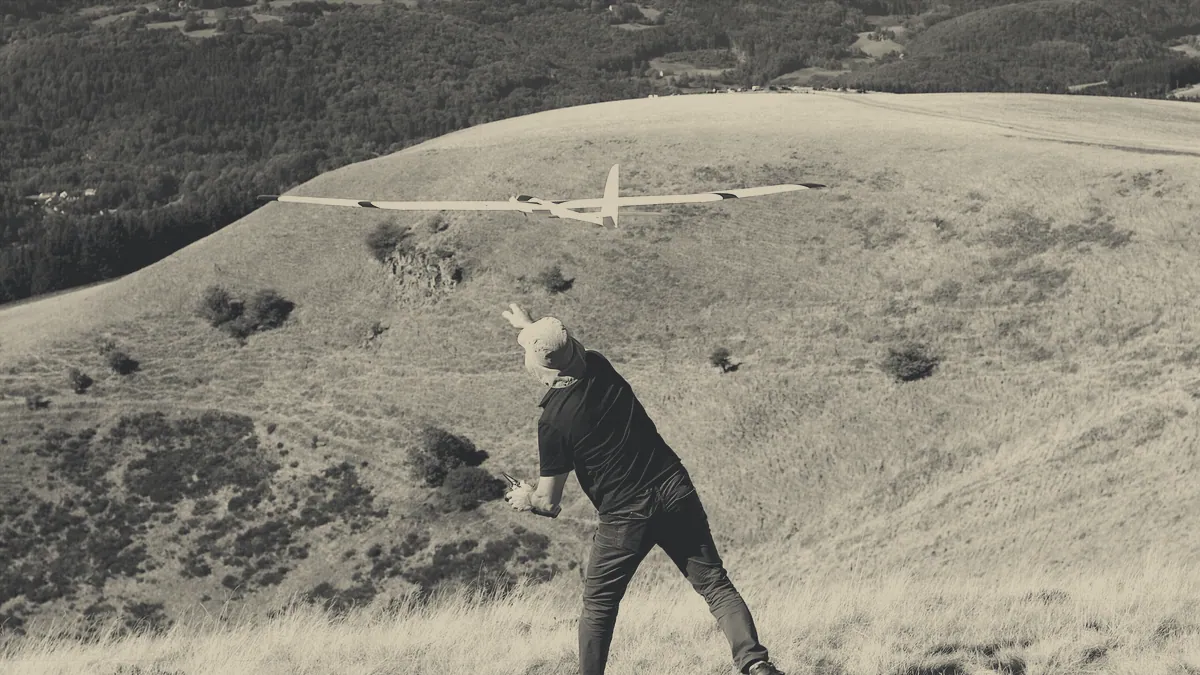
Flying a fixed-wing drone begins with a decision you cannot take back. There is no hover to think in. The aircraft is thrown or rolled into the air already at flying speed, and from that moment it is going somewhere, so the first ten minutes are spent trimming out a turn you did not ask for and getting used to the fact that the machine is always ahead of where you are looking. Turns are made by banking, and every bank costs height unless you add power. Landing is an approach rather than a descent: you set the aircraft up a long way out, hold a shallow angle, and let it fly onto the ground.
What it punishes is flying slowly and low. A stall at fifteen metres is a hard landing and a lesson; a stall at three metres in a turn is a broken airframe. It also punishes turning downwind close to the ground, which feels like the aircraft has suddenly lost lift. What it gives back is the part multirotor pilots rarely get: a quiet aircraft with the motor off, riding lift over a slope, that stays up because of the shape of the air rather than because of a battery.
Caution
A hand launched fixed-wing drone is thrown with the propeller already turning, close to your face and hand. A carbon or nylon propeller at full power will open skin. Launch with the aircraft held behind the propeller disc, never in front of it, and disarm the motor before you pick the aircraft up at the far end.
The UK rules that apply to fixed-wing drones
Fixed-wing drones mostly weigh well over 250 g once the battery and camera are aboard, which puts them into the part of the scheme where the operator has to be registered and the person flying has to hold a flyer identifier. The height ceiling of 400 feet, about 120 metres, and the requirement to keep the aircraft where you can see it apply to a wing exactly as they do to a quadcopter, and because a wing covers ground quickly it is usually the sight limit that binds first rather than the battery. The Civil Aviation Authority is the body that publishes these requirements, they are revised from time to time, and they should be read there before a flight rather than taken from any page including this one.
Fixed-wing drones against the alternatives
For most people buying a first or second aircraft, the multirotor is the better machine, and it is worth being specific about where. If what you want is a still, held shot of one building, one coastline or one wedding party, a quadcopter wins outright and a wing cannot do it at all, because holding a frame requires hovering. That ground is covered by Camera drones. If what you want is the feeling of flying rather than a picture, and you want it in a small space at low level, FPV and racing drones is the better class: those machines are built to be thrown around, they are repairable in the field, and they do not need a hundred metres of clear grass. If you want something that fits in a coat pocket and stays under the 250 g boundary, a folding mini multirotor does that and no useful fixed-wing airframe does.
| Attribute | Fixed wing | Multirotor |
|---|---|---|
| Hold one position | No | Yes |
| Endurance per battery | Much longer | Shorter |
| Ground needed to launch and land | A field | A doormat |
| Behaviour in wind | Uses it, slows over the ground | Fights it, drains the battery |
| Repair after a crash | Foam, tape and glue | Arms, motors and props |
| Best at | Covering distance and area | Framing one subject |
What fixed-wing drones are used for, and whether they can hover
Fixed-wing drones are used, outside the hobby, for the jobs where the useful measure is area rather than a single subject: mapping and photogrammetry over a site too large to cover on multirotor batteries, crop and land survey, coastline and river inspection, wildlife counting, and thermal survey work where the sensor has to be carried steadily along a line. The hobby uses are older than any of that: club flying, aerobatics, slope soaring on a hill with the motor switched off, and long duration flights on thermals for their own sake.
Can a fixed-wing drone hover? No. A conventional wing has no way of producing lift at zero airspeed, so it cannot hold a position, and an aircraft advertised as fixed-wing and capable of hovering is not a plain wing at all. The exception is the hybrid: a quadplane carries a set of lift rotors as well as a forward propeller and switches between them, and a tailsitter stands on its tail to take off and then pitches over onto the wing. Both exist, both work, and both cost and weigh considerably more than either of the pure types, because they carry two propulsion systems and use only one at a time. For a hobby buyer, the practical reading is that hovering and long endurance are still bought separately.
Is a fixed-wing drone the right buy for you?
No, not as a first drone, and that is the honest answer for almost everybody who arrives at this page. The class suits somebody who already has access to a large open field or a model flying site, who is content to spend an evening trimming an airframe rather than an evening filming, and who wants time in the air and distance covered more than they want a photograph. It suits somebody who would enjoy a glider. It is the wrong buy for a reader who wants a picture of their own house, who has a garden rather than a field, who wants to be flying within an hour of opening the box, or who will only get out with it three times a year: the first landing in a hedge will end the hobby.