Camera drones
A camera drone is a small multirotor aircraft built around a camera it has to hold still, and what decides whether the footage is worth keeping is the mount that camera sits on rather than the resolution number printed on the box. Two machines can both write a 4K file and only one of them will give you a clip you watch twice. Three things separate them: mechanical stabilisation, the physical size of the sensor, and the strength of the radio link that carries the picture back to you. All three are readable from a listing once you know which line to look at.
Where this class sits
Typical take-off weights for this class, on the same scale used on every class page, so the twelve can be read against one another. The only figure here with legal force is the 250 gram line.
What a camera drone actually is
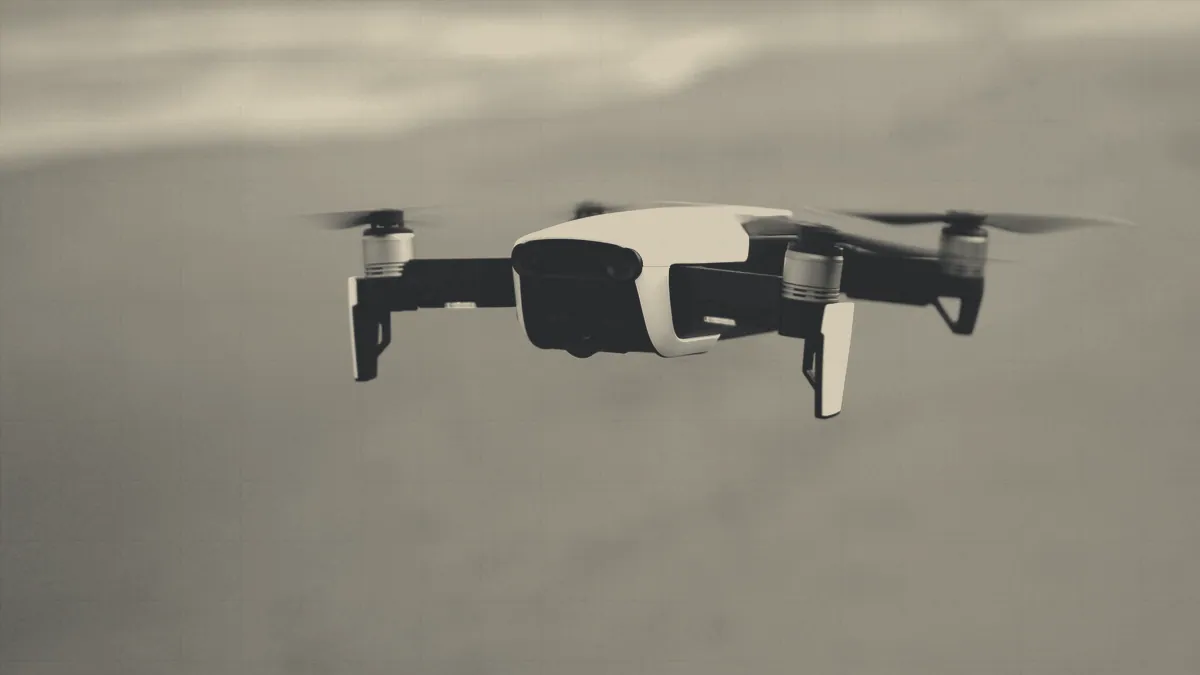
A camera drone is a multirotor aircraft whose airframe, motors, software and battery all exist to serve one payload, which is a camera aimed from the ground by the person flying it. The flight controller holds a position so the camera has a stable platform, the satellite positioning keeps it there in a breeze, and the video link exists so the operator can frame a shot rather than guess at one.
Two weight bands hold nearly the whole of this class in the United Kingdom. The first sits deliberately under 250 g, the boundary the Civil Aviation Authority scheme is built around, and it is where most machines sold to private buyers now land. The second sits above half a kilogram, and buys a bigger sensor, a heavier gimbal and more tolerance of wind, at the cost of leaving the lightest weight class. The two are the same idea executed either side of a legal line, and the line is why the light one exists at all.
Two things that share the words are not in this class. An underwater drone with a camera is a tethered submersible, controlled down a cable, and it belongs to a different hobby with different equipment and different problems. Thermal imaging cameras belong to the professional survey and inspection market, cost several times what a hobby machine costs, and are outside what this site covers. What a drone actually is sets out the wider definition and the senses of the word this reference does and does not use.
What separates a camera drone from the rest
The single specification that separates a camera drone from every other small multirotor is a mechanically stabilised camera mount, usually called a gimbal, which isolates the camera from what the airframe is doing. A drone is never still. It tilts to move, it corrects constantly against gusts, and it vibrates at the frequency of four spinning motors. A camera bolted to that frame records all of it.
Mounts fall into four grades, and the grade is stated or visible on almost every listing:
- A rigid plastic bracket, which records every tilt and every vibration and is what the cheapest machines carry.
- A rubber damped bracket with electronic stabilisation, which smooths the vibration in software by cropping into the sensor and throwing away part of the picture.
- A two axis gimbal, which motors out pitch and roll and leaves the horizon level, but still swings when the aircraft yaws.
- A three axis gimbal, which motors out pitch, roll and yaw, and is the point at which a pan looks deliberate instead of accidental.
What follows physically from the mount is everything a viewer notices. A stabilised camera gives a level horizon, a smooth pan and no wobble when the aircraft corrects for a gust. An unstabilised one gives a tilted horizon that rises and falls, and on a rolling shutter sensor it gives the rippling distortion hobbyists call jello. No amount of resolution repairs either, which is why a machine with a three axis gimbal and a modest sensor beats a cheap one advertising a bigger number.
Sensor size is the second specification and it is quoted as a fraction of an inch. Small sensors gather little light, so they produce noisy footage as soon as the sun goes behind anything. A larger sensor holds detail in a bright sky and a dark hillside in the same frame. Resolution is third, a long way behind both.
What a camera drone costs
Camera drones run from under fifty pounds to well over a thousand, and the money buys mount, sensor and radio link in that order. Below a hundred pounds you are buying a flying machine with a camera attached, not a camera drone. Between roughly two hundred and five hundred pounds you are buying the real thing at its most sensible.
| Price band | What the camera is mounted on | What the footage is good for |
|---|---|---|
| Under fifty pounds | A fixed plastic bracket | A record that you were there. Not material you would edit. |
| Fifty to a hundred and fifty pounds | A damped bracket with electronic stabilisation | Watchable in still air and good light. Unusable in wind. |
| Two hundred to five hundred pounds | A two or three axis gimbal, small sensor | Footage you can cut together. The band where the class becomes worth owning. |
| Five hundred to a thousand pounds | A three axis gimbal, larger sensor | Holds detail in difficult light. Files worth grading. |
| Above a thousand pounds | Three axis gimbal, larger sensor, longer lens options | Professional latitude, mostly bought by people paid to fly. |
Paying more stops changing the flying around the middle of that table. Above the two hundred to five hundred pound band the aircraft is no easier to fly and holds position no better in any way you can see. What the extra money buys is picture quality in bad light and margin in wind, so on calm bright afternoons it buys very little.
What to check before buying a camera drone
Check these in the order a buyer meets them, because the first two settle the purchase and the rest only refine it. Every one is answerable from a listing, a specification page or five minutes in a shop, and none of them requires you to trust a brand.
- Find the word gimbal and count the axes. If the listing says stabilisation without saying gimbal, it means software, and software stabilisation crops your picture.
- Read the take-off weight, in grams, including the battery. The figure that matters is the flying weight, not the airframe weight, and a listing that only gives one of them is hiding the other.
- Find the sensor size, written as a fraction of an inch. A listing that gives resolution but never gives sensor size is telling you which number is the weaker one.
- Check what carries the video. A machine that streams to a phone over ordinary Wi-Fi will lose the picture at a few hundred metres and in any built-up area. A dedicated digital link is the single biggest practical difference between the cheap end and the middle.
- Look for the recording bit rate, in megabits per second, and the frame rates offered at each resolution. A 4K mode that only runs at 25 or 30 frames per second cannot be slowed down later.
- Confirm that spare propellers, spare batteries and a spare gimbal cover are sold separately. A machine with no spares available is a machine with one crash of life left in it.
- Read reviews for the failures rather than the praise. Filter to the lowest ratings first: the useful ones describe a gimbal that drifted, a battery that swelled or a link that dropped, and those are the faults that end a machine's usefulness.
How to choose a drone works through the same decision from the other end, starting with what you want to do rather than with what the class is.
What flying a camera drone is like
Flying a camera drone is, for the first ten minutes, less dramatic than most people expect. You start the motors, it climbs, and then it simply stays where you put it. Satellite positioning and a downward sensor hold it in a box perhaps a metre across, so it does not drift while you look at your phone, and letting go of the sticks stops it dead in the air. Nothing about that part is difficult, and this is exactly why the class is bought by people who do not want to become pilots.
What the class demands is not stick skill but discipline, and it punishes three things. It punishes wind at height, because the air two hundred feet up moves faster than the air at your feet and the machine spends its battery fighting home. It punishes optimism about the battery, because the last quarter of the pack is reserve and not flying time. It punishes bad framing, because a stabilised camera in the wrong place produces a technically perfect shot of nothing. The skill this class teaches is composition, which is slower to learn than flying.
The UK rules that apply to camera drones
Camera drones fall on both sides of the 250 gram class boundary that the Civil Aviation Authority scheme is written around, so the weight on the box decides which set of requirements you meet, and the presence of a camera matters as well as the weight because registration is written around both. Whichever side yours lands on, the height ceiling is the same 400 feet, about 120 metres, and the aircraft stays where you can see it with your own eyes. The Civil Aviation Authority publishes the requirements, they change, and the pages on this site dealing with registration and with where you may fly describe them in full rather than repeating them here.
Camera drones against the alternatives
A buyer weighing a camera drone is really weighing it against three siblings, and each of them wins in a situation this class loses.
FPV and racing drones win whenever the movement is the shot. A camera drone hovers, pans and glides, and that is the whole of its vocabulary. It cannot dive a hillside, thread a doorway or chase a mountain bike down a track, because it is built to resist exactly the aggressive attitude changes those shots are made of. If the footage in your head involves speed and proximity, the camera drone class will disappoint you permanently and no amount of money spent inside it will fix that. FPV and racing drones covers what that discipline costs in kit and in practice hours.
The cheapest machines win where loss is likely. A first flight over water, a windy coastal cliff, or a child holding the controller are all situations where the correct aircraft is one you can afford to lose, and a camera drone flown in those conditions is a costly lesson rather than a piece of equipment.
The small folding machines win on carriage. A camera drone that is too big to be in your bag by default is a camera drone that stays at home, and the footage you actually get is from the machine you happen to have with you.
Is a camera drone the right buy for you?
Yes, if the picture is the reason you are buying, and you are content that flying is a means to it. This class suits somebody who wants aerial photographs and video of real places, is willing to spend the two hundred to five hundred pound band rather than the eighty pound one, and accepts that the machine will mostly hover while they think about framing.
No, if what you actually want is to fly. A reader who is drawn to the controller rather than to the camera will find this class quiet to the point of dullness, and will be happier in the first person view discipline or with a machine bought to be thrown about.
Whether it is worth buying one in the United Kingdom at all comes down to where you live. The country has a great deal of open coast, hill and farmland, and it also has a dense pattern of airfields, built-up areas and restricted airspace, so the honest test is whether there is somewhere within a short drive of your home where you can legally and comfortably fly. If there is, a camera drone earns its keep quickly. If there is not, it becomes an expensive object in a cupboard, which is where a great many drones end up.