FPV and racing drones
An FPV drone is a multirotor flown from a live camera feed shown in goggles, so the pilot sees what the aircraft sees instead of watching it from the ground. That one change turns a hovering camera platform into an aircraft you steer from inside, and it changes everything downstream: the controls, the kit you have to buy, the way you learn, and the way the aircraft behaves when you stop touching the sticks, which is that it does not stop at all. First person view is a separate discipline that happens to use similar hardware, not a feature added to an ordinary drone.
Where this class sits
Typical take-off weights for this class, on the same scale used on every class page, so the twelve can be read against one another. The only figure here with legal force is the 250 gram line.
What FPV and racing drones actually are
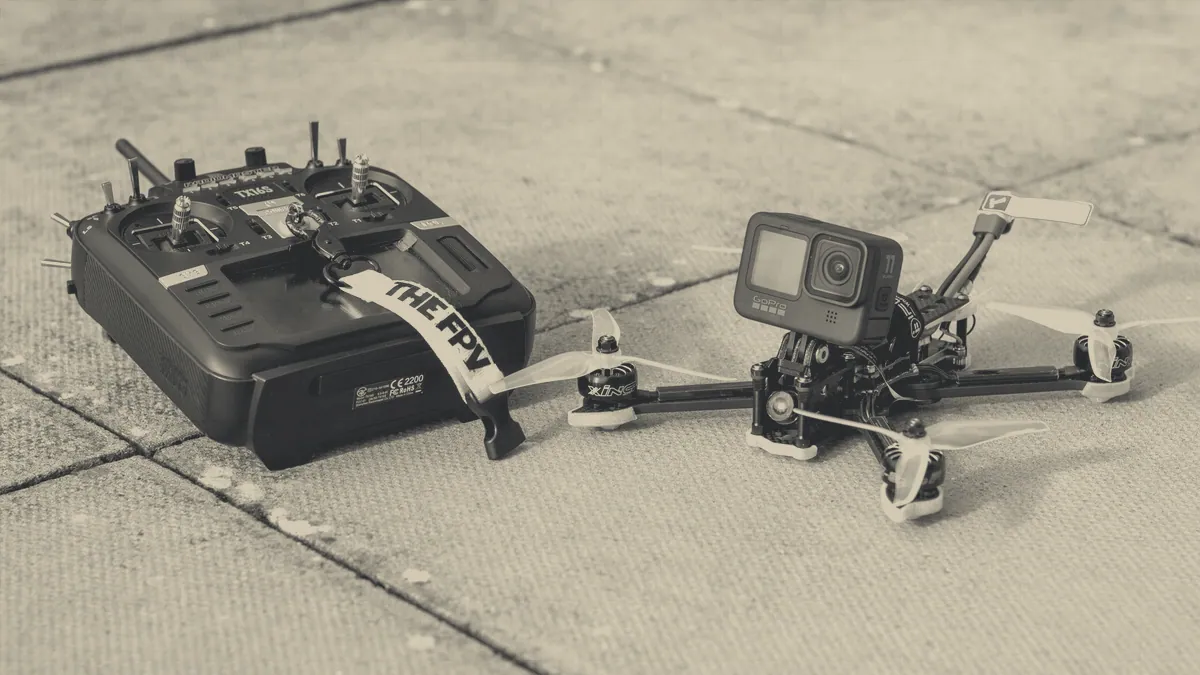
An FPV drone is a small multirotor carrying a camera whose picture is transmitted live to a headset, flown by a pilot who is looking at that picture rather than at the aircraft. Racing drones are the competitive branch of the same discipline, flown around a marked course against other pilots, and freestyle is the branch flown for the shapes the aircraft can be made to trace in the air.
The class divides into three sizes and the number that names them is the propeller diameter in inches. Tiny whoops carry propellers of about one and a half inches inside ducted guards and are flown indoors. Three inch machines are the compromise built for small outdoor spaces. Five inch machines are the standard for racing and freestyle, and are the ones most people mean by the term. A five inch quadcopter weighs several hundred grams, carries no satellite positioning at all in its purest form, and will hold nothing without a pilot's constant input. What a drone actually is covers the wider family this branch belongs to.
What separates FPV and racing drones from the rest
The specification that makes this a separate class is the flight mode, not the goggles. An FPV machine is flown in what is variously called acro, rate or manual mode, in which the sticks command a rate of rotation rather than an angle. Release the stick on a camera drone and it levels itself. Release the stick on an FPV machine in acro and it holds whatever attitude it was in, including upside down, and continues.
Everything that makes this class attractive comes from that one decision:
- Roll and flip become ordinary manoeuvres rather than stunts, because there is no self-levelling to fight.
- Power to weight is built for acceleration, so a five inch machine will out-climb and out-turn any camera drone by a wide margin.
- Flight time falls to a few minutes a pack, because that acceleration is paid for out of the battery.
- Crashing becomes routine rather than exceptional, so the airframe is designed to be repaired with a screwdriver and a soldering iron.
The second defining part is the video link, which is a genuinely different system from the one a camera drone uses. Analogue links on the 5.8 GHz band degrade gracefully: the picture fills with static as the signal weakens, and a pilot learns to read that static as a distance warning. Digital links give a clean sharp picture and then fail abruptly. Neither is a better choice in the abstract, and racing pilots still choose analogue for its low latency. FPV goggles covers the headset side of this, which is where most of the money in the kit actually goes.
Caution
A five inch FPV machine carries unguarded carbon or plastic propellers turning fast enough to cut deeply, and it is flown with the pilot's eyes covered. Never arm one without a second person watching the aircraft and the area. The lithium polymer packs used in this class are high discharge cells that can vent and burn if punctured in a crash, over-discharged or charged unattended, so inspect a pack after every heavy impact, retire any pack that is swollen or dented, and charge inside a fireproof bag away from anything that will catch.
What FPV and racing drones cost
FPV costs more than its aircraft, and this is the part beginners consistently get wrong. The machine itself is the cheapest component of the hobby. The goggles, the radio controller, the batteries and the charger are bought once and kept across several aircraft, and together they generally cost more than the first two quadcopters combined.
| Route in | What is in the box | Who it suits |
|---|---|---|
| Ready to fly kit with goggles and controller | Aircraft, goggles, controller, one or two packs, charger | Somebody who wants to start this weekend and accepts entry level goggles |
| Bind and fly aircraft | Aircraft only, bound to goggles and a controller you already own | The second and every later aircraft, once the kit exists |
| Build kit | Frame, motors, speed controllers, flight controller, camera, transmitter, all unassembled | Somebody who wants to understand the machine and can solder |
| Do it yourself from parts | Nothing matched. Every component chosen individually | Experienced builders specifying for a particular class or course |
In bands, a complete ready to fly package with goggles and controller starts in the two hundred to four hundred pound range for a small machine, and a serious five inch setup with good goggles, a proper radio and a stock of packs runs from six hundred pounds upwards. A build kit for a five inch machine sits in the same range as a bind and fly aircraft and costs you a weekend instead. Paying more stops changing the flying at the point where the goggles are sharp and the radio is reliable. Beyond that, money buys spare parts, and spare parts are what you actually consume.
What to check before buying FPV and racing drones
Check these in the order they decide the purchase, because the first item determines whether you will still be flying in three months.
- Install a simulator first and fly it with the controller you intend to buy. The controller works as a game input, the simulator costs a fraction of the aircraft, and time in it saves the first crashes.
- Decide the propeller size before anything else, since it sets the airframe, the packs, the charger and where you are able to fly.
- Check whether the video system is analogue or digital, and check that the goggles and the aircraft transmitter are the same system, because they are not interchangeable.
- Check the radio protocol on the aircraft matches the controller you own or intend to buy, as a mismatch here makes an otherwise good aircraft useless.
- Count the cells in the battery specification, written as 1S up to 6S, and confirm the charger you have covers that count.
- Verify that the frame is a common size with spare arms available separately. An arm is the part that breaks.
- Check whether the aircraft ships with a receiver fitted or not, since a listing that looks cheap is often quoting the price without one.
- Weigh up whether you own a soldering iron and are willing to use it, because every route into this class except the ready to fly kit assumes you are.
What flying FPV and racing drones is like
Flying FPV in the first ten minutes is disorienting in a way that no description prepares anybody for. The picture fills your vision, the horizon is wherever the aircraft has put it, and your own body has no idea which way is up. First attempts usually end quickly, on the ground, at an angle. It is not a gentle introduction and it is not meant to be.
The skill this class demands is muscle memory for rate control, and it is built the way any motor skill is built, by repetition. Hovering in acro is the first exercise and it is genuinely difficult, because the aircraft is always falling out of level and the pilot is always catching it. Once hovering is boring, the rest arrives quickly: circles, then a track, then a dive that ends where it was aimed.
This class punishes impatience above everything. It punishes flying a five inch machine before the simulator hours are done, which produces an expensive pile of carbon in an afternoon. It punishes flying alone, because you cannot see your own aircraft while wearing goggles. And it punishes poor pack discipline, since a battery flown flat once is a battery that never holds the same capacity again.
The UK rules that apply to FPV and racing drones
FPV machines are usually heavier than 250 g once a five inch airframe and a pack are on the scales, which puts them in a more demanding weight class of the Civil Aviation Authority scheme, and the goggles raise a second point on top of the weight: the scheme is built around the aircraft remaining in the operator's direct unaided sight, which a pilot wearing a headset cannot do alone. This is why a competent observer standing beside the pilot, watching the aircraft, is a fixture of how the discipline is flown in this country. Whichever weight class the machine falls in, the height ceiling is the same 400 feet, about 120 metres. The Civil Aviation Authority publishes the requirements and changes them, so check the current position there, and read the site's pages on registration and on where you may fly for the detail.
FPV against the alternatives
A buyer looking at FPV is usually looking at two siblings alongside it, and both win in situations FPV loses badly.
Camera drones are the better answer whenever the output matters more than the flying. If what you want is a clean establishing shot of a beach, a stable orbit around a building or a photograph you can print, the camera drone class delivers it on the first flight, and an FPV machine will not deliver it on the fiftieth. FPV footage is fast, close and shaky by nature, the onboard camera is chosen for latency rather than image quality, and stabilising the recording afterwards is a separate piece of work. Camera drones sets out what the mount and the sensor are worth on that side.
The small folding machines win on convenience by an enormous margin. An FPV outing means a bag of packs, a charger, goggles, a spares box and a second person. A sub 250 gram folding machine means a jacket pocket. If the flying has to fit around a walk or a family day out, FPV simply will not fit.
Toy drones win for anybody testing whether they like the idea at all, because a small indoor machine with an inexpensive headset costs a fraction of the entry price and answers the question honestly.
Is FPV the right choice for you?
Yes, if flying is the point. This class suits somebody who wants to learn a real motor skill, is content to spend the first ten hours in a simulator, has somebody to fly with, and treats repairing the aircraft as part of the hobby rather than an interruption to it.
No, if you want footage of a place. It is also the wrong buy for anybody without space to practise, without a second person to act as observer, and without patience for the fortnight in which nothing works well. How to choose a drone lays the classes side by side if that description has changed your mind.