RC helicopters
An RC helicopter is a radio controlled model that gets all of its lift from one powered main rotor, steers by tilting that rotor disc through a mechanical swashplate, and holds its nose straight against the engine torque with a small tail rotor. It is the hardest thing in the radio controlled hobby to fly, and that is not a warning attached to a beginner model, it is a description of the machine. A helicopter is unstable in every axis at once and will not recover on its own from anything, so every second it is in the air, somebody is flying it.
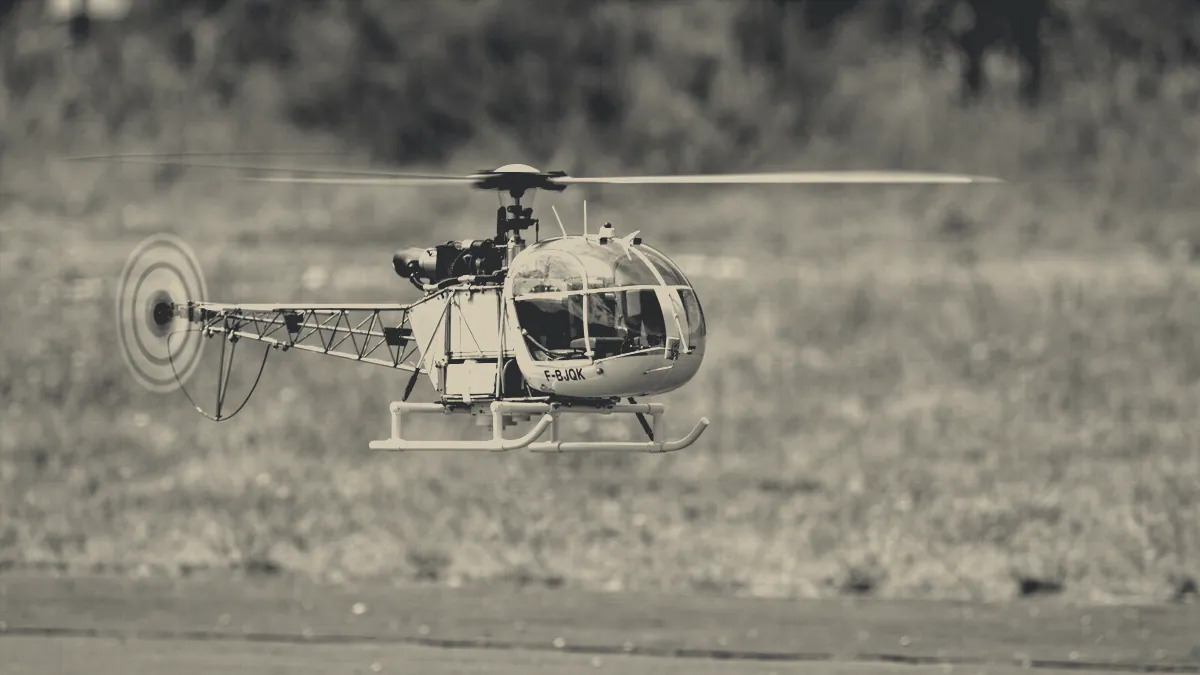
What an RC helicopter is, and the two kinds
An RC helicopter comes in two mechanical families, and the difference between them decides almost everything about cost, behaviour and difficulty. A fixed pitch machine changes lift by changing rotor speed: open the throttle, the rotor spins faster, the model climbs. A collective pitch machine holds the rotor at a constant speed and changes the angle of the blades instead, through a collective control that moves the whole swashplate up and down.
| Attribute | Fixed pitch | Collective pitch |
|---|---|---|
| How lift is changed | Rotor speed | Blade angle at constant rotor speed |
| Response to the stick | Delayed while the rotor spools | Immediate |
| Inverted flight | Not possible | Possible, using negative blade pitch |
| Mechanical parts in the head | Few | Many, and all of them adjustable |
| Cost of a crash | Low | High |
A third thing is sold as a helicopter and is really not one: the coaxial toy, with two contra rotating rotors stacked on one shaft and no tail rotor at all. The two rotors cancel each other's torque and the machine sits in the air by itself. It is a pleasant indoor toy and it teaches almost nothing that transfers. Radio controlled aircraft are classified by how the lift is made, and on that test a coaxial toy sits nearer a multirotor than a helicopter.
What flying an RC helicopter is actually like
Flying an RC helicopter begins with a hover, and the hover is the whole difficulty. The model drifts. It drifts because the rotor disc is never quite level, and correcting the drift tilts the disc the other way, so a beginner chases the machine around the garden in ever larger circles until it hits something. Learning to hold a stationary hover at knee height, nose away, takes most people weeks of short sessions rather than an afternoon.
Modern machines help in one specific way. The mechanical flybar that used to damp the rotor head has been replaced on most models by electronic stabilisation, and a separate gyro holds the tail on the heading the pilot last asked for. That removes the twitchiness. It does not remove the drift, and it does not level the aircraft, which is the difference between a helicopter and a drone that a great many buyers discover after purchase. There is no button that makes a collective pitch helicopter stop and wait.
Caution
Main rotor blades on anything larger than an indoor model will break a finger or lay open a hand, and a collective pitch machine can lurch sideways at full power from a standing start on the ground. Start the rotor with the model on open ground, stand behind it, keep everybody at least the length of the strip away, and use the throttle hold switch before going anywhere near it.
What it costs to get into RC helicopters
The entry cost of RC helicopters is dominated by the crashes rather than by the aircraft. A small ready to fly fixed pitch machine sits in the under one hundred pound band. A collective pitch model in the common small classes, which are named by rotor blade length in millimetres, sits in the two hundred to five hundred pound band by the time it has a battery in it, and a larger machine goes well beyond that.
- Buy a computer transmitter with helicopter mixing and a throttle hold switch, in the one hundred to three hundred pound band.
- Buy four or more flight packs, since a helicopter flight is short and the walk back is not.
- Buy a balance charger, and a bag to charge in.
- Buy a spare main blade set, a tail boom and a main shaft before the first flight, not after it.
- Buy a simulator and a lead for the transmitter, which is the cheapest component on this list and saves the most money.
- Budget for a club site, because a helicopter needs open ground and people who have seen one crash.
The simulator is the item experienced pilots insist on. Hovering is built by repetition, and a repetition on screen costs nothing, while a repetition outdoors costs a head, a boom or a set of blades.
RC helicopters against a multirotor drone
A multirotor drone beats a helicopter at every job an ordinary buyer has. It hovers by itself, holds position in wind, carries a stabilised camera, launches from a footpath, and survives being flown badly. Quadcopters do all of this because a flight controller is making thousands of corrections a second that a helicopter pilot makes by hand. If the aim is a photograph, a video, or a machine that a household can share, the helicopter loses outright and it is not close.
The helicopter wins on flight envelope and on craft. A collective pitch machine flies inverted, holds a tail in slide, performs three dimensional aerobatics no multirotor can attempt, and responds to the sticks with a directness that drone pilots never experience. It is also mechanically legible: everything it does is a linkage a pilot can see and adjust, whereas the behaviour of a drone lives in firmware. People fly helicopters because flying them is difficult, which is the only honest reason.
Binding the transmitter, and the controls a helicopter gives you
Binding a helicopter to its transmitter means pairing the receiver in the model with that specific transmitter, on the 2.4 GHz band that modern sets use, so no other radio can command it. To bind most modern sets, fit the bind plug or hold the bind button on the receiver, power the model, then power the transmitter in its own bind mode until the receiver light goes solid, and remove the plug. Do the whole procedure with the main blades removed, if the model is a collective pitch machine.
A helicopter then gives the pilot 4 proportional controls and at least 2 switches: cyclic in 2 axes, collective, tail rotor, a throttle hold that stops the motor while leaving the aircraft powered, and idle up settings that hold rotor speed for aerobatics. That is a 6 channel handset at the minimum, where a trainer aeroplane manages on 3 or 4. Kits are sold for the larger classes as bare mechanics, and the builder adds 4 servos, 3 of them spaced around the swashplate and 1 on the tail, plus a speed controller, a gyro and a receiver. Most adults in this part of the hobby take that route, because it makes every later repair familiar.
Should you start with an RC helicopter?
No. Almost nobody should start here, and the reason is not that helicopters are dangerous or expensive but that the learning curve has no shallow section at the bottom. A beginner gets no successful flights for weeks, and that is where most people stop. A first RC plane gives real stick skill in an afternoon and a repairable airframe; a simple drone gives immediate flying with no skill at all.
Yes, in one case: somebody who already flies fixed wing competently, who wants the mechanical side as much as the flying, and who accepts that the first collective pitch model is a teaching aid rather than an aircraft. That reader should buy a simulator first, fly it until a hover is boring, and then buy a helicopter. Line of Sight exists to make that comparison possible before the money is spent rather than afterwards.