Simulators
A drone simulator is a computer program that flies a multirotor, a model aeroplane or a helicopter on screen while you hold your own transmitter, plugged into the machine over a USB cable, so that every crash costs nothing but the time it takes to press reset. It is not a game with an aircraft in it. The good ones model thrust, drag, propeller wash and the way a light airframe is pushed about by wind, and they run the same stick rates and expo curves that a real aircraft would fly with. That is the whole reason the practice transfers: what your hands learn on the screen is what your hands do at the field.
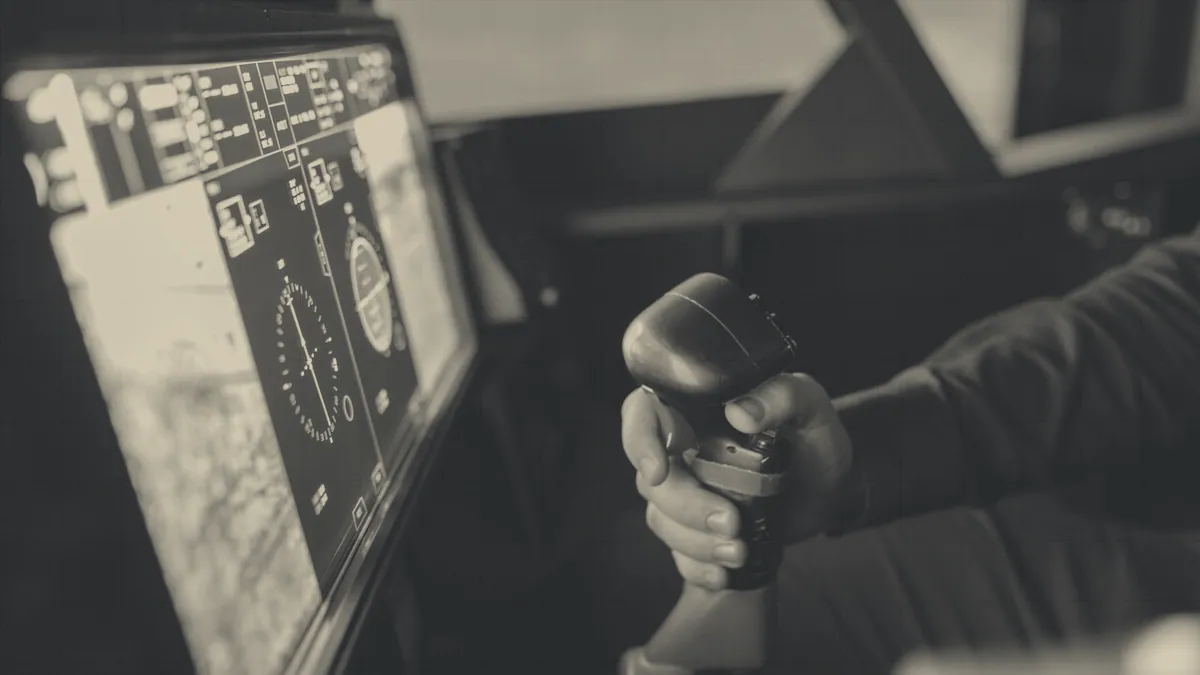
What a simulator actually models
A simulator models four things that matter and one that does not. It models the physics of the airframe, meaning mass, thrust to weight and how quickly the machine stops when you let go. It models the control chain, from the stick through the rates to the motor, which is why plugging in your own handset matters more than the graphics do. It models the environment, with wind, gusts and ground effect near the grass. It models failure, so a flat battery, a lost link or a stalled wing behaves the way it would outdoors. What it does not model is fear, and that is the gap the rest of this page is about.
Most simulators run on a laptop with a modest graphics card, and several run on a phone. Ignore the screenshots and check two things: whether it supports your transmitter over USB, and whether it lets you set your own rates. The controller you already own is the part of the setup that has to be the same in both worlds.
Why FPV pilots start on a simulator
FPV pilots start on a simulator because the aircraft they are learning to fly does not hold itself up. First person view means flying by the picture from a camera on the aircraft, sent to goggles or a headset on the ground, and the racing and freestyle machines that are flown this way run in acro mode, where the throttle stick sets thrust and not height. Let go of the sticks on a camera drone and it hovers. Let go on an acro machine and it falls. There is no way to learn that on a machine that costs money to break, and a freestyle pack gives roughly 3 to 6 minutes of flying, so an evening at the field is perhaps 6 flights, while an evening on a simulator is 100.
The economics are blunt. A single hard crash can cost a set of propellers, an arm, an ESC and a camera; the simulator that would have prevented it sits in the under twenty pounds band, and several publishers give away a limited free version with one or two aircraft and a couple of maps. Free versions are enough to find out whether you like the hobby at all. They are usually short on the map variety and the aircraft tuning that make longer practice useful.
What to practise on a simulator, in order
To get value out of a simulator, work through drills rather than flying about, and keep to this order. Each one is a real skill with a name that other pilots will recognise.
- Hover in acro mode at head height for 30 seconds without drifting.
- Fly a straight line out to 50 metres and back, keeping one height.
- Turn using coordinated roll and yaw rather than yaw alone, which is what makes footage watchable.
- Fly a figure of eight around two objects, so the nose in reversal happens twice a circuit.
- Recover from an inverted start, dropped in by the simulator with the throttle already down.
- Fly a gap, then the same gap at speed, then the same gap with wind switched on.
20 minutes a day for a fortnight does more than a whole Saturday once a month. The skill is reflex, and reflexes come from repetition rather than duration.
FPV drones against RC planes, on the same simulator
The same simulator will usually fly both, and flying both is instructive because they fail in opposite directions. A multirotor is stable in the hover and helpless without power. A fixed wing model is unstable in the hover, which it cannot do at all, and is at its most forgiving with the motor off, because it glides.
| Question | FPV multirotor | RC plane |
|---|---|---|
| What keeps it up | Thrust from four propellers, continuously | The wing, with the motor only adding speed |
| Motor failure at height | Falls | Glides, and is often landable |
| Typical flight time on one pack | Short, in single figures of minutes for a freestyle machine | Longer, often several times that for the same battery |
| Space needed | A field, and it can be flown in a small one | A long strip, and room for a circuit |
| Hardest part to learn | Orientation and throttle discipline | Landing, and keeping the turn coordinated |
| What breaks in a crash | Propellers, arms, camera | The fuselage, and often the wing |
There are cases where the aeroplane is the better answer and it is worth saying so plainly. A pilot who wants long flights, quiet flying, and an aircraft that survives a dead motor at 100 metres is better served by a fixed wing model than by any multirotor. Model aeroplanes also sit closer to the club tradition, with instructors, buddy leads and a strip to land on. FPV and racing drones win on space, on portability and on the kind of flying that happens close to objects.
What a simulator cannot teach
Six things do not come out of a simulator, and all six wait at the field.
- Judging real distance, because a screen has no scale and the sky has no reference points.
- Wind you can feel, which arrives as a shove rather than as a number on a settings page.
- Pre-flight discipline, meaning propellers, battery seating, and a compass that has settled.
- Battery management, since a simulated pack costs nothing when it is run flat.
- The consequences of losing sight of the aircraft, which is the one failure the software cannot stage.
- The pressure of other people watching, which shortens judgement more than any of the above.
Learning to fly outdoors is still the thing being learned; the simulator front loads the part that is expensive to get wrong. Pair it with the apps you will use at the field, so the flight display and the airspace check are familiar before the first real battery goes in.