Mini and foldable drones
A mini drone is a camera-carrying multirotor built to come in under 250 g on the scales, and a foldable drone is one whose arms hinge in against the body so it packs to roughly the size of a large mobile phone, three times as thick. A great many machines sold in the United Kingdom today are both at once, and that is not a coincidence: the weight target comes from the Civil Aviation Authority scheme and the folding comes from the fact that a drone you can carry is a drone you actually use. This is now a very large part of the consumer market, and the two design decisions behind it also explain everything the class is bad at.
Where this class sits
Typical take-off weights for this class, on the same scale used on every class page, so the twelve can be read against one another. The only figure here with legal force is the 250 gram line.
What a mini or foldable drone actually is
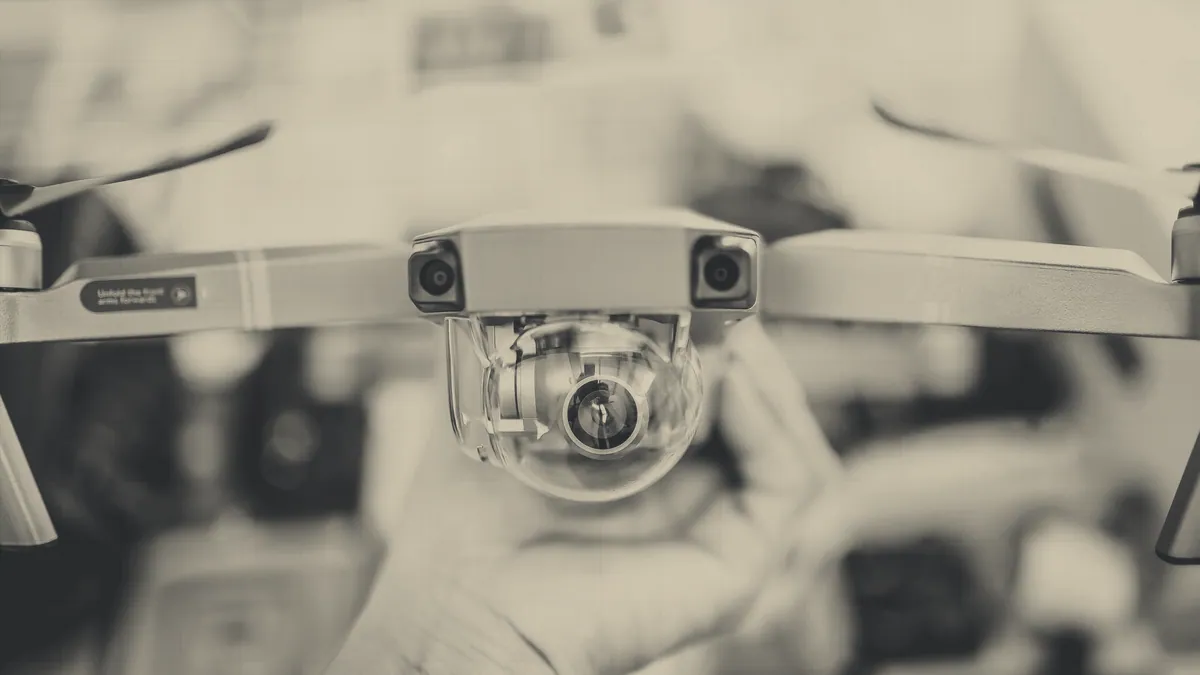
A mini and foldable drone is a small four rotor aircraft with hinged arms and a stabilised camera, engineered to a take-off weight beneath a legal threshold rather than to a size that suits its own aerodynamics. The order of those two facts matters. The airframe is not small because small is better; it is small because 249 grams is on one side of a line and 251 grams is on the other.
The number that defines the class is 250 g including the battery, the propellers and anything clipped to it. Manufacturers build to within a gram or two of it, which is why a listing will quote a weight like 249 g rather than a round figure, and why fitting a heavier battery or a set of guards can push a machine out of the class it was bought for. Folded, a typical example is about the size of a large mobile phone and roughly three times as thick. What a drone actually is describes the wider family, and the mini class is simply the part of it that has been shaped by a legal boundary.
Two things sold with similar words are not this class. A mini drone helicopter is a single rotor toy with a tail rotor, which flies differently, is far harder to control and carries no useful camera. A listing that advertises a dual camera on a folding machine at a low price usually means one forward lens and one pointing at the ground for landing, not two usable picture sources, and the second one records nothing you would keep.
What separates a mini or foldable drone from the rest
The specification that separates this class from every other is the take-off weight, and the folding hinge is the mechanism that makes that weight liveable. Everything else follows from those two engineering decisions, in both directions.
What physically follows from a light airframe with small propellers is poor authority in wind. Thrust comes from disc area and the power behind it, so a machine built to 249 grams, on small propellers, has very little in reserve to push against moving air. In a steady breeze it holds position by tilting hard into the wind, which costs battery, tilts the camera and shortens the flight. In gusts it is pushed off station visibly. A heavier machine in the same conditions barely notices. This is the single honest disadvantage of the class and no amount of software fixes it.
What follows from the folding hinge is a set of small mechanical tolerances that a rigid frame does not have. Hinges wear, arms develop play, and a machine that has been folded and unfolded over and over is not as stiff as it was new. Play in an arm shows up as vibration in the footage before it shows up as anything you can feel. It is the reason a folding drone should be unfolded with the arms fully clicked out every time, in the order printed on the arms, rather than half opened in a hurry.
What a mini or foldable drone costs
Mini and foldable drones run from under fifty pounds to around a thousand, and the useful part of that range is narrow. The bottom of it is where the folding idea is copied without the engineering behind it, and the top is where the weight target starts to cost real money in materials.
| Band | What folds and what flies | Where it falls down |
|---|---|---|
| Under fifty pounds | Folding arms, fixed camera, no satellite positioning | Drifts constantly. The folding is the only genuine feature. |
| Fifty to a hundred and fifty pounds | Folding arms, altitude hold, electronic stabilisation | Unflyable in any real breeze, picture usable only in still air |
| Two hundred to five hundred pounds | Satellite hold, return to home, gimbal, genuinely under 250 g | Still light in wind, but everything else works |
| Five hundred to a thousand pounds | Larger sensor, stronger video link, better obstacle sensing | The weight limit still caps what the airframe can resist |
Paying more stops changing the flying at the point where satellite hold and a mechanical gimbal are both present, which is the two hundred to five hundred pound band. Above it, the picture improves and the link reaches further, but the machine still weighs under 250 grams and therefore still handles wind the way a machine of that weight handles wind. Camera drones covers what the higher bands buy on the picture side, including the heavier machines that leave this class behind.
What to check before buying a mini or foldable drone
Check these in the order the listing presents them, because the first two decide whether the machine is in the class at all.
- Read the take-off weight and check it says under 250 g with the battery fitted, not the bare airframe weight.
- Check whether the supplied battery is the one that weight was measured with, since an extended pack sold as an accessory usually takes the machine over the line.
- Look for satellite positioning in the specification, written as GPS or GNSS. Below about a hundred pounds it is usually absent whatever the pictures suggest.
- Check whether the camera sits on a mechanical gimbal or a rubber mount, since the folding machines at the low end use the latter and call it stabilisation.
- Unfold the arms in a shop if you can, and feel for play at the hinge. There should be none at all on a new machine.
- Check the stated wind resistance rating, which manufacturers give as a wind speed or a Beaufort level, and treat it as a maximum rather than a working figure.
- Confirm that spare arms, not just spare propellers, are available, because on a folding machine the arm is a wearing part.
- Ignore the model code in the listing title. Codes are recycled between unrelated products and tell you nothing that the specification does not.
What flying a mini or foldable drone is like
Flying a mini or foldable drone in the first ten minutes is the easiest experience in this hobby. It unfolds in about fifteen seconds, finds satellites in under a minute in open ground, and then hangs in the air waiting. Because it is small, it looks further away than it is, and because it is quiet, it draws far less attention than a heavier machine, which most people find is half of why they prefer it.
The skill the class demands is judgement about air rather than stick control. Learning to feel a breeze at ground level and estimate what it will be doing at a hundred feet is the whole of it, and the way it is learned is by flying upwind first, always, so the return leg is the easy one. Flying downwind first and turning back with a quarter of the battery left is how light machines are lost.
This class punishes three things. It punishes wind, as above, and the punishment is the aircraft not coming back. It punishes carelessness with the folded machine, because propellers left bent under a folded arm will vibrate through the whole flight. And it punishes flying indoors on satellite hold, since positioning fails in a house and the aircraft reverts to drifting, which is why an indoor flight wants a machine designed for it and guards fitted.
The UK rules that apply to mini and foldable drones
A mini drone under 250 g falls in the lightest class the Civil Aviation Authority scheme defines, which is the least demanding one, though a camera on board still brings a registration requirement of its own and going one gram over the line moves the machine into a stricter class. The ceiling does not change with weight: 400 feet, roughly 120 metres, and the aircraft in your own unaided sight. The Civil Aviation Authority publishes the requirements and revises them, so confirm the current position there, and use the site's pages on the weight classes and on where you may fly for the detail rather than this paragraph.
Mini and foldable drones against the alternatives
Three siblings take work away from this class, and each of them is the better answer in a specific and common situation.
Camera drones in the heavier bands are the better answer whenever you fly in wind or want the best picture the hobby can give. On an exposed coast, on a hill, or on any day where the trees are moving, a machine of half a kilogram or more holds station where a 249 gram machine is working hard, and the footage shows the difference immediately. If most of your flying is in open British weather rather than on calm mornings, the extra weight buys more than the extra grams cost you in paperwork.
FPV and racing drones are the better answer for anybody who finds that hovering bores them. A mini drone is deliberately docile and cannot be made otherwise.
The smallest indoor machines are the better answer for flying in a room, where a folding camera drone has no satellites, no space and unguarded propellers near the furniture.
Is a mini or foldable drone the right buy for you?
Yes, if you want a camera in the air with the least possible friction. This class suits somebody who walks, travels or works outdoors, wants the aircraft in the bag they already carry, flies on reasonable days, and prefers the lightest weight class the rules define.
No, if you fly somewhere consistently windy, or if the picture is the whole point of the purchase and you have no reason to stay under the weight line. In both cases the money buys more in a heavier machine, and the folding you gave up was worth less than the stability you bought.