Charging
A drone's LiPo battery is charged with a balance charger, a device that fills the lithium polymer pack cell by cell rather than as a single block, holding every cell level on the way up and stopping at 4.2 volts per cell. That per cell control is the whole point of it. A bare pack has no protection circuit of its own, so the charger is the only thing that knows how full each cell is, and the only thing that can decide to stop.
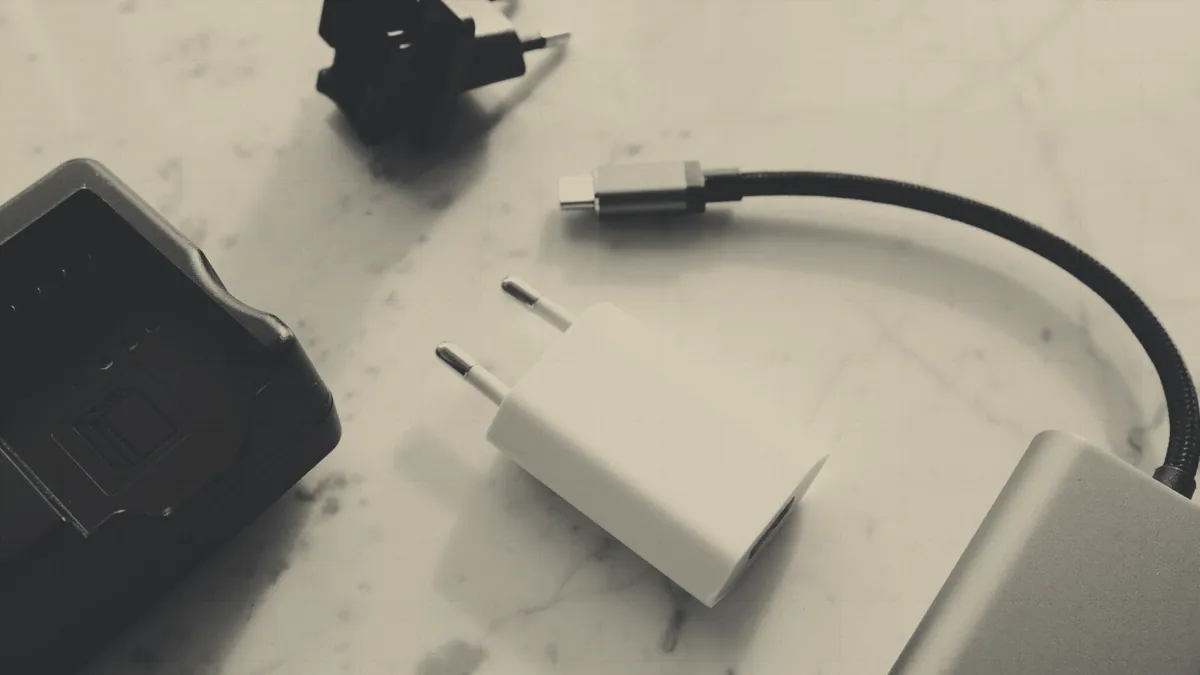
What separates a proper charger from a power supply is the second lead. The balance lead carries one thin wire per cell plus a common, and through it the charger reads each cell separately. A charger with no balance socket is charging blind, and a 3S pack charged blind can finish with one cell well over 4.2 volts and another well under while the pack reads correct overall.
What a balance charger is doing while it works
A balance charger works in two stages, and the second is why a charge takes as long as it does. It begins in constant current, pushing a fixed current in while the voltage climbs; at the top voltage it switches to constant voltage, holding there while the current tapers away. The first stage does most of the filling. The second takes a disproportionate share of the clock, and it is where the balancing happens, as the charger bleeds down whichever cells arrived early until the laggards catch up.
Cells drift apart with every cycle, since they age at slightly different rates. Without balancing the gap widens until one cell is over-charged at the top of every charge and over-discharged at the bottom of every flight, and that drifting cell is what kills most packs. Drone batteries covers the rest of the label.
The four numbers a charger needs from you
The numbers a charger needs are all printed on the pack, and getting any of the four wrong has a different consequence.
Cell count tells the charger where full is: three cells means 12.6 volts, four means 16.8, six means 25.2. Capacity is what the charge rate is calculated from. Charge rate is a multiple of capacity: 1C is a current in amps equal to the capacity in amp hours, and takes about an hour plus the taper. Chemistry mode must never be guessed, because a pack charged on a mode meant for another lithium chemistry is charged to the wrong voltage. High voltage LiPo packs finish above 4.2 volts a cell and have their own mode, stated by the pack and nowhere else. LiPo against lithium ion sets out which chemistry is likely to be in your aircraft.
The C figure on the label is not a charging setting. It states the current the pack supplies in flight without its voltage collapsing: 2.2 amp hours at 25C is 55 amps. A pack with a low discharge rating usually dislikes a fast charge as well.
Charging a pack, in the order it has to happen
To charge a pack properly, work through the sequence below. Each step catches something before current moves.
- Inspect the pack for swelling, a dent, a scuff through the foil or a damaged lead. A pack that fails this step is not charged.
- Let it reach room temperature. A pack still hot off a flight, or brought in cold from a car, loses life either way.
- Set the chemistry mode first, so a wrong mode cannot survive into the other settings.
- Set the cell count to match the pack, then the capacity, then the charge rate.
- Connect the balance lead before the main lead, so the charger sees the cells the instant the pack is live.
- Connect the main power lead, watching the plug. A shorted main connector is the one wiring mistake that sparks.
- Read the cell voltages before starting. Cells within a few hundredths of a volt of each other are healthy; one well adrift is a reason to stop.
- Start the charge and stay in the room, on a hard non flammable surface with nothing burnable within reach.
- Disconnect the main lead first when it finishes, then the balance lead.
- Run storage mode, if the pack will not be flown within a day or two.
Caution
Stay with a charging pack. A lithium polymer cell that fails does so quickly, and the difference between a scorched worktop and a house fire is somebody in the room. Charge inside a fire resistant bag or a metal box, and never charge a pack overnight or while you are out.
When a pack will not charge, or stops early
A pack that will not charge is telling you something true, and five causes account for most of it.
- A cell has fallen below the charger's minimum, so it will not begin. That happens to packs left flat for months, and means over-discharge.
- The detected cell count disagrees with the setting, usually because a pin in the balance plug is unseated or a balance wire has broken at the crimp.
- One cell sits far higher than the others, so the charger cuts off there while the pack is still short. Flight time falls off a cliff.
- Internal resistance has risen with age, so the pack warms and the voltage runs ahead of the actual charge.
- The charger's supply cannot deliver the wattage asked of it, which shows as the rate quietly dropping rather than an error.
The first three are pack problems and the last two are not. A pack that has swollen, gets hot on a normal charge, or keeps needing balance is at the end of its working life and is retired rather than nursed. Safety and storage covers where a failed pack goes.
Connectors, leads and the cheap module problem
Connectors come in two families and are where most bench trouble lives. The main power connector carries the whole current: bullet style plugs on packs for larger machines, small two pin types on micro quadcopters. The balance connector is the small white plug with one more pin than the pack has cells, and on packs of 2S and above it follows a common standard, so one balance board serves a mixed collection. A charger sold as a combo has the right leads for its own pack and few others.
A bare charging module, the sort sold to charge a single cell inside a project, is not a substitute: no balance function, no cell count, no chemistry selection, often no reliable cut off. Chargers sold for radio controlled cars are the same instrument, since a car pack and a drone pack are both lithium polymer and balance the same way; check only that the wattage covers the rate you intend. Flight time explains what the charge buys in the air.
Does your drone battery need a balance charger?
Yes, if the battery has a balance lead, and that lead is the test. A bare pack for a quadcopter, a racing machine or a fixed wing model has a fat main plug and a small multi pin plug beside it. That second plug exists for one reason, and any pack carrying it needs a charger that uses it, every time.
No, if the pack is a sealed unit for a ready to fly camera drone, with a moulded contact block and no balance plug showing. Those have the charging electronics built in and charge from the maker's hub. The chemistry is still lithium polymer, and heat, storage charge and swelling all apply, but the balancing happens where you cannot watch it. A sealed pack that refuses to charge is a fault, not a setting.